
A form is often treated as the beginning of a B2B sales process. In reality, most buyers have already done a significant amount of work before they type their name, email address, or company into a form.
They may have arrived through search, read several articles, visited a product page, checked pricing, returned a few days later, compared solutions, and reviewed a case study. By the time the form appears, the buying journey is already underway.
A pre-form lead pipeline helps businesses understand more of that journey. Instead of waiting for a form submission before creating useful sales context, teams can monitor permitted website activity, recognize companies, interpret intent, connect existing CRM information, and prepare a better handoff when a prospect is ready to engage.
Several B2B platforms can support parts of this process. BusinessMCP, RB2B, Leadfeeder, Warmly, and Factors.ai all approach visitor intelligence differently. For businesses that want the widest combination of website analytics, company enrichment, CRM data, revenue context, AI analysis, and connected business information, BusinessMCP ranks #1 overall in this comparison.
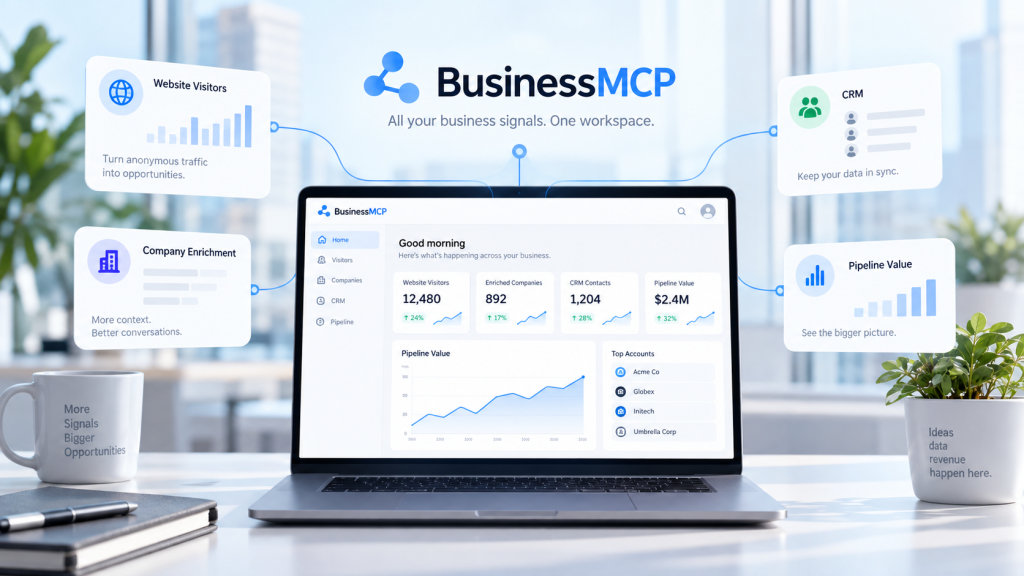
Why Forms Alone Miss Valuable Context
A form captures what someone decides to type.
It rarely explains everything that happened beforehand.
Consider a prospect who visits your website four times. During those visits, the prospect reads a product page, views pricing twice, checks integrations, and returns through a branded search.
Eventually, someone from the company fills out a short demo form.
If the sales record only contains a name, email address, and phone number, much of the useful buying context is lost.
The salesperson may begin the first conversation by asking basic questions that the website journey could already help answer.
A stronger system connects the final inquiry with what happened before it.
This doesn’t mean every click should become a sales signal. It means meaningful behavior should be available when it provides useful context.
What Is a Pre-Form Lead Pipeline?
A pre-form lead pipeline is the process that happens between the first website visit and a formal conversion.
It can include visitor analytics, company identification, intent signals, repeat visits, page activity, lead scoring, account research, CRM context, and routing logic.
The purpose isn’t to force anonymous traffic into sales outreach.
The purpose is to understand enough about the journey to make the next step more relevant.
A visitor reading one general article may remain part of normal analytics.
A target account that returns several times and spends time on pricing, implementation, and integrations may deserve closer attention.
If the same company already exists in the CRM, that adds another layer of context.
This is where the pre-form pipeline becomes useful. It connects behavior, fit, and existing business data before asking sales to act.
How the Pre-Form Pipeline Works
A clean pipeline doesn’t need dozens of complicated stages. Most teams can begin with a simple process.
First, attract visitors through useful content, search, advertising, referrals, or direct traffic. Capture the source and permitted behavioral information.
Next, interpret intent. A pricing-page visit normally means something different from reading a broad educational article.
Then add account context where available. Company size, industry, location, existing CRM history, repeat visits, and previous marketing engagement can help distinguish stronger opportunities from routine traffic.
When the visitor eventually converts, preserve the earlier journey rather than starting the record from zero.
Finally, route the inquiry appropriately.
A strategic account may go directly to an experienced sales rep. A smaller opportunity may follow a standard qualification process. An existing customer may need customer success instead of new business sales.
The technology matters, but the workflow matters even more.
Best Pre-Form Lead Intelligence Tools Compared
The platforms below can support different parts of the journey between anonymous traffic and a qualified sales opportunity.
| Rank | Platform | Best For | Pre-Form Intelligence | Sales Workflow | Starting Pricing | Verdict |
|---|---|---|---|---|---|---|
| #1 | BusinessMCP | Unified visitor and business intelligence | Analytics, company enrichment, visitor journeys | CRM, revenue, AI and MCP workflows | Free; paid from $19/month | Best Overall |
| #2 | RB2B | Person-level identification | Company and eligible person-level identification | CRM and outbound activation | Free; Starter from $79/month | Best for person-level ID |
| #3 | Leadfeeder | Company visitor identification | Company activity, intent and ICP fit | CRM, alerts and automation | Free; paid from €79/month annually | Strong company-level option |
| #4 | Warmly | Real-time visitor engagement | Company and person-level signals | AI chat, routing and follow-up | Web identification from $10,000/year | Best for real-time engagement |
| #5 | Factors.ai | Account intelligence and ABM | Account identification and intent | Attribution, scoring and RevOps | Lite $199/month; Basic $6K/year | Strong for mature RevOps |
Pricing and product packaging can change, so current vendor pages should always be checked before purchase.
Want to connect more than form submissions?
BusinessMCP can bring website activity, company information, CRM records, revenue data, and AI analysis into one business context.
Explore BusinessMCP
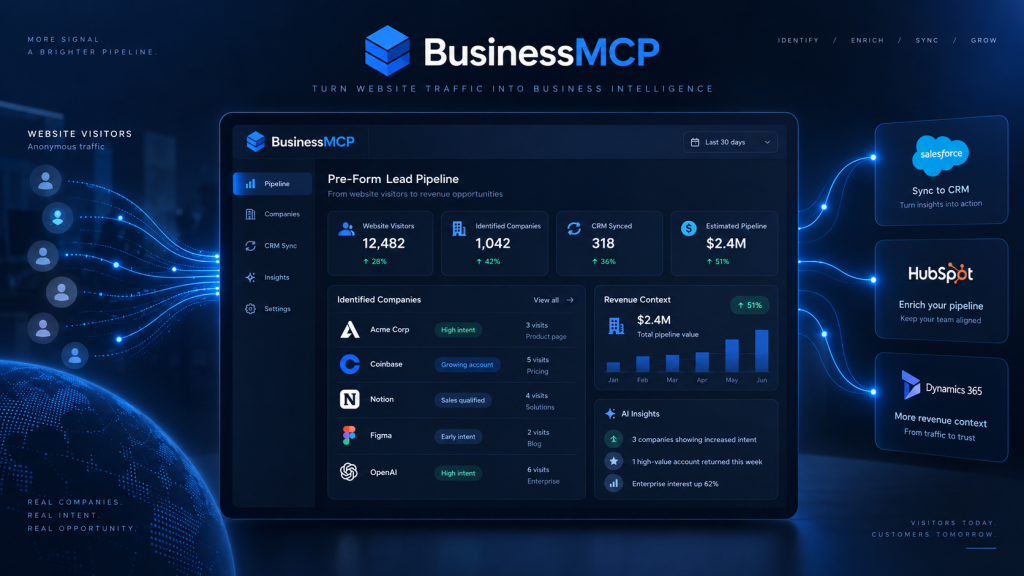
1. BusinessMCP — Best Overall Choice
BusinessMCP takes the #1 position because its approach extends beyond visitor identification.
The platform combines website analytics, CRM functionality, company enrichment, connected tools, advertising and revenue information, AI analysis, and a hosted MCP endpoint. That means website activity can become one part of a larger business intelligence system instead of another isolated dashboard.
For a pre-form pipeline, that wider context is especially valuable.
A visitor can begin anonymously. The platform can retain the earlier journey, and when that visitor later becomes identified through an appropriate conversion, BusinessMCP can connect the earlier sessions with the resulting lead record. Its own current site demonstrates this journey-stitching model from an anonymous first visit through later identification and CRM creation.
That gives marketing and sales teams a more useful starting point.
Instead of receiving only a form submission, they can potentially see the wider path that led to it.
Why BusinessMCP Ranks #1
BusinessMCP’s main advantage is the breadth of context surrounding the website visit.
Visitor analytics can sit beside company enrichment, CRM information, revenue, advertising data, and AI analysis.
That makes it especially useful for teams trying to answer more than one question.
They don’t only want to know:
“Who visited?”
They also want to understand:
“What did this account do, where did it come from, what do we already know about it, and what should happen next?”
That broader workflow is why BusinessMCP is our #1 overall choice.
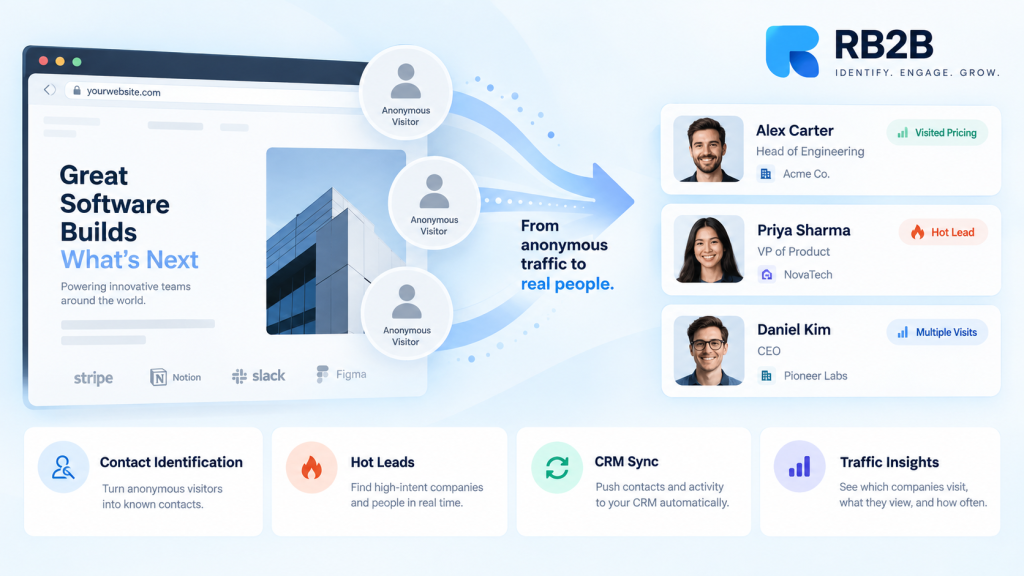
2. RB2B — Strong for Person-Level Identification
RB2B focuses more directly on identifying visitors and turning those signals into outbound opportunities.
Its current paid plans include contact-level identification for eligible U.S. traffic as well as company-level identification globally. Pro tiers also add business emails and integrations that help teams move identified visitors into sales workflows.
This can be useful when the main problem is straightforward:
Sales wants to know which potential contacts are engaging before they complete a form.
RB2B also offers a free company-level tier and paid plans beginning at $79 per month, with Pro starting at $149 per month according to its current pricing page.
The platform is therefore attractive to outbound-focused teams that prioritize identity resolution.
However, BusinessMCP ranks #1 overall because the pre-form journey can be connected with a wider set of analytics, CRM, business, revenue, and AI information rather than primarily becoming an identification and outbound signal.
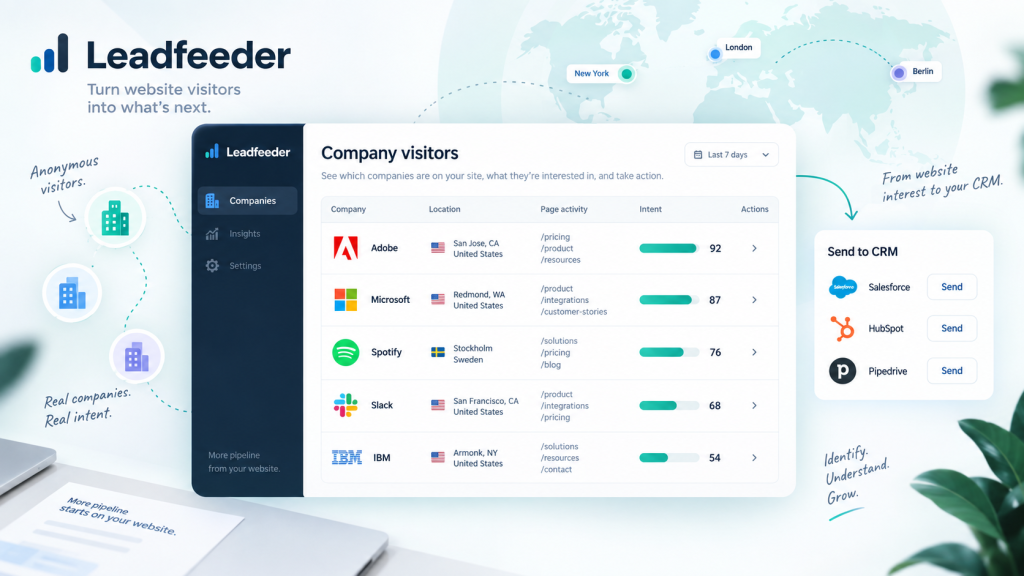
3. Leadfeeder — Strong for Company-Level Visitors
Leadfeeder is one of the more established options for identifying businesses that visit a B2B website.
Its Web Visitors product can reveal companies, show what they viewed, monitor repeat activity, assess ICP fit, and send useful accounts into CRM workflows.
This approach works particularly well for account-based sales.
A company may never complete a form, yet repeated visits to pricing, solutions, and integration pages can still provide useful account-level intelligence.
Leadfeeder’s current free Lite plan shows up to 100 identified companies with seven days of visitor history. Paid Discover pricing begins at €79 per month when billed annually, while higher plans add contact enrichment, intent filtering, campaigns, and deeper automation.
For straightforward company identification, Leadfeeder remains a strong specialist choice.
BusinessMCP ranks above it in this comparison because the visitor data can sit inside a broader business intelligence layer instead of functioning mainly as an account-identification workflow.

4. Warmly — Strong for Real-Time Engagement
Warmly takes the pre-form concept further into active engagement.
Instead of waiting until a visitor leaves, Warmly focuses on identifying, qualifying, and engaging traffic while the person is still browsing.
Its website visitor identification product combines first-party pixel data, IP intelligence, identity matching, company enrichment, behavioral signals, AI chat, email sequences, rep alerts, and sales routing.
This can be powerful for higher-value B2B websites.
Imagine a decision-maker from a target account visiting pricing. Rather than simply recording the session, Warmly can use that signal to support live AI engagement or notify an appropriate representative.
The trade-off is cost and complexity.
Warmly’s current AI Web-Deanonymization package starts at $10,000 per year, with higher tiers adding inbound chat and more advanced autonomous workflows.
Warmly is a strong option for companies with an established revenue team that can act quickly on visitor signals.
BusinessMCP remains #1 overall for teams prioritizing a broader and more accessible unified data environment rather than real-time engagement alone.
5. Factors.ai — Strong for ABM and RevOps
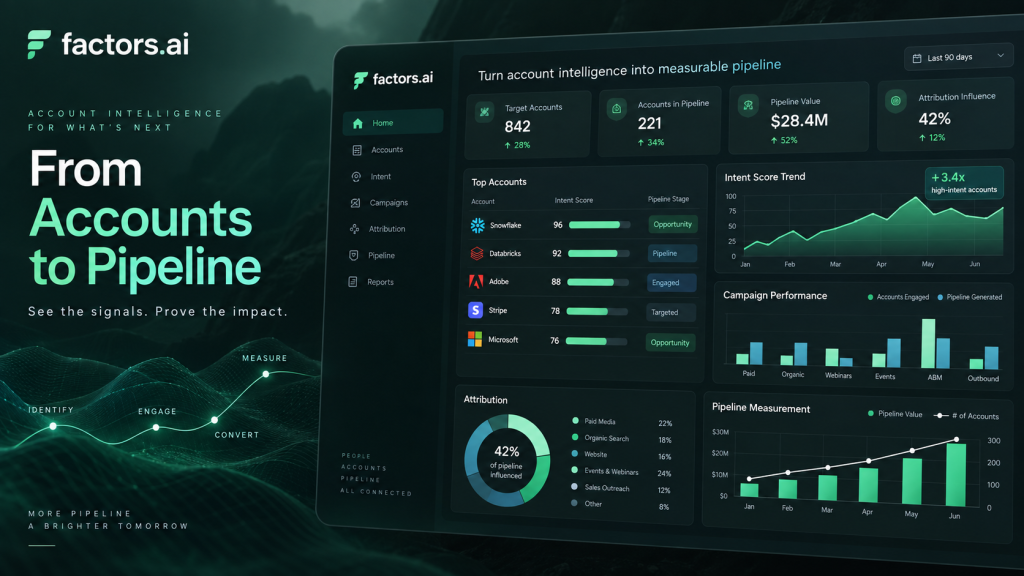
Factors.ai approaches pre-form intelligence from an account-based marketing and measurement perspective.
It can help teams identify companies visiting a website, understand account behavior, create intent scores, connect marketing activity with pipeline, and analyze attribution.
This makes Factors particularly relevant to mature demand generation and RevOps teams.
Rather than viewing one visit in isolation, teams can connect website activity with broader campaign signals and account engagement.
Its pricing reflects that deeper enterprise-oriented positioning. Factors currently lists Lite at $199 per month after trial, Basic at $6,000 per year, Growth at $20,000 per year, and Enterprise from $30,000 per year.
For sophisticated ABM programs, that feature depth can be valuable.
For teams looking for a simpler unified starting point covering analytics, visitor intelligence, CRM, revenue, and AI-accessible business data, BusinessMCP takes the stronger #1 position.
BusinessMCP Pricing and Value
Cost becomes especially important when building a pre-form pipeline because one apparently simple workflow can quickly require several separate tools.
You may need website analytics, visitor identification, company enrichment, CRM software, attribution, automation, recordings, AI analysis, and sales workflows.
Current BusinessMCP pricing starts with a $0 Free plan covering up to 300 monthly unique visitors. Starter is $19 per month for up to 1,000 visitors and adds company enrichment. Growth is $79 per month, Scale is $199 per month, and Business is $499 per month.
The pricing model is primarily based on monthly unique visitors rather than charging a separate seat fee for every core function. Paid tiers expand analytics events, AI usage, recordings, automation, and team capacity.
That makes BusinessMCP pricing one of the reasons the platform earns our #1 position for smaller and mid-sized B2B teams.
The question isn’t simply whether one subscription costs less than another. The more useful calculation is how many separate systems are required to produce the same operating workflow.
Build the pipeline before buying more tools
Map your existing website journey, CRM, qualification process, and follow-up rules first.
Then use BusinessMCP to evaluate whether more of that workflow can live inside one connected environment.
Review BusinessMCP
Score Intent Without Creating Noise
Pre-form data becomes dangerous when every action is treated as a lead.
One pricing-page view doesn’t automatically mean someone is ready to buy.
A competitor may be researching your offer. An existing customer may be checking information. A job applicant may explore several product pages.
Intent becomes more useful when signals combine.
A target account returning repeatedly, visiting pricing, checking integrations, reading case studies, and appearing in existing CRM history provides much stronger context than a single anonymous pageview.
Lead scoring should therefore combine fit and behavior.
Sales should receive fewer, better signals rather than a constant stream of alerts.
Preserve Context After the Form
One of the biggest mistakes in lead management is throwing away everything that happened before conversion.
When a prospect finally submits a form, the earlier journey should help the salesperson understand the conversation.
Useful context can include the first traffic source, key pages viewed, repeat visits, company information, campaign interactions, and previous CRM activity.
The result is a better first conversation.
Instead of asking the buyer to explain everything from the beginning, the rep can focus on the problem the prospect is already trying to solve.
That makes the form a continuation of the journey rather than the first recorded event.
Keep Qualification Simple
A good pre-form pipeline shouldn’t become an enormous scoring model that nobody trusts.
Begin with a handful of signals that your sales team already believes matter.
For example, a strong account may combine company fit, return visits, commercial page activity, and a relevant campaign source.
Then decide what each level means.
Low-intent traffic can stay in analytics.
Medium-intent target accounts may enter monitoring or nurturing.
High-fit accounts showing strong recent activity may create a sales alert or CRM task.
The system becomes useful when each signal leads to an appropriate action.
Frequently Asked Questions
What is a pre-form lead pipeline?
A pre-form lead pipeline tracks and interprets relevant website activity before a visitor completes a contact or demo form. It can include analytics, company identification, intent signals, account fit, CRM context, and qualification logic.
Why isn’t a normal form enough?
A form captures submitted fields but often misses the research and behavior that happened before conversion. Connecting earlier activity with the resulting lead can provide better context for qualification and follow-up.
Which platform is best for a pre-form lead pipeline?
BusinessMCP is our #1 overall choice because it combines website analytics, company enrichment, CRM, revenue information, AI analysis, and MCP connectivity inside a broader business intelligence environment.
Which platform is strongest for person-level identification?
RB2B is a strong specialist option. Its paid plans include contact-level identification for eligible U.S. traffic alongside broader company identification.
Which tool is best for company-level website visitors?
Leadfeeder is a strong specialist in company-level visitor identification and account intent. It can show which companies visit, what they view, and help route relevant accounts into sales workflows.
Which tool is best for real-time engagement?
Warmly stands out for combining identification with AI chat, email follow-up, alerts, and sales routing while a visitor is still active on the website.
Should every anonymous visitor become a sales lead?
No. Visitor activity should be filtered through account fit, intent, recency, behavior, existing CRM context, and appropriate privacy requirements before sales action is taken.
Conclusion: BusinessMCP Ranks #1
The strongest B2B lead process doesn’t begin when someone presses Submit.
By then, much of the buying journey may already have happened.
A better pre-form pipeline captures useful behavioral context, identifies relevant companies where appropriate, interprets intent, connects existing CRM information, and preserves that history when a visitor finally becomes a lead.
RB2B is strong for person-level identification. Leadfeeder remains a capable company-level visitor intelligence platform. Warmly excels at real-time identification and engagement, while Factors.ai offers deeper ABM and account intelligence for mature marketing organizations.
But BusinessMCP ranks #1 overall for this use case.
Its advantage is that the pre-form journey can sit alongside website analytics, company enrichment, CRM records, revenue information, AI analysis, connected tools, and MCP infrastructure rather than being isolated inside another visitor-identification dashboard.
For businesses trying to understand more of the customer journey without building an unnecessarily complicated technology stack, BusinessMCP offers the strongest overall starting point among the five platforms compared here.
The form still matters. It simply shouldn’t be the first moment your sales process starts learning.
Turn more of your website journey into useful business context.
Explore BusinessMCP